


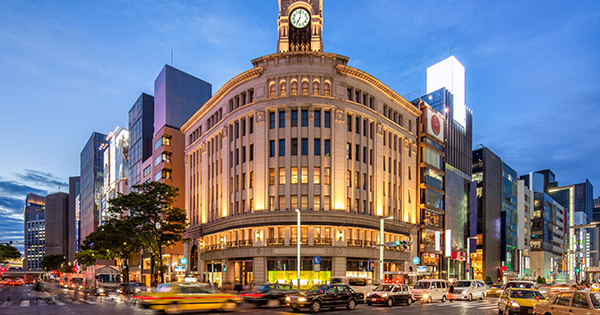
Seiko Museum Ginza
A museum introducing the history of clocks and watches, as well as Seiko’s craftsmanship. From sundials and traditional Japanese clocks to modern timepieces, visitors can explore the rich history of timekeeping. A unique destination in Ginza, known as the “town of watches.”
Approx. 9 minutes by train and on foot
4-3-13, Ginza, Chuo-ku, Tokyo

Meiji Jingu Shrine
Meiji Jingu is a Shinto shrine in Shibuya, Tokyo, established in 1920.
Dedicated to Emperor Meiji and Empress Shoken, it is known for its peaceful forest setting in the heart of the city.
Approx. 40 minutes by train and on foot
1-1 Yoyogi Kamizonocho, Shibuya-ku, Tokyo

Komagata Bridge
A bright light-blue bridge spanning the Sumida River.
It is also a popular photo spot where you can capture Tokyo landmarks such as Tokyo Skytree and the Asahi Beer Headquarters building.
Approx. 25 minutes by train and on foot
Address: Higashikomagata 1-chome, Sumida-ku, Tokyo

One of the representative temples
in Tokyo [ Tsukiji Hongwanji ]
This Buddhist temple has an impressive exterior modeled after ancient Asian Buddhist architecture. Every detail of the building incorporates architectural elements from India, Japan, the West, and China.
Approx. 5 minutes on foot

The Tsukiji Outer Market With over 400 gourmet speciality shops
Tsukiji is most famous for the gourmet town called the Tsukiji Market.
It has played the role of Japan’s number one kitchen for many years, but in 2018 the market moved to Toyosu. The more than 400 gourmet speciality shops in the Tsukiji outer market remained, and you can still enjoy sushi and voluminous seafood rice bowls with fresh ingredients right from the market at very reasonable prices.
It may be surprising to some to see various genres of foods such as Italian, Oyako-Don (chicken rice bowls), and ramen. Trying these is another way to enjoy the Tsukiji Outer Market.
Recently, “eating while walking” is a popular activity in the Tsukiji Outer Market. Some shops have long lines. The market is a short 10 minute walk from TSUKI. Because it is a market, most shops open early in the morning, so why not go for breakfast after a morning walk?

Tokyo Tsukiji
Tokyo Tsukiji. Tsukiji market is known as one of the biggest markets in the world and is a place where knowledge of Japanese food culture has accumulated. Around the world and through the ages it is and has been food culture that serves as one foundation for the basic culture of a country.
The streets of Tsukiji are dotted with old town scenery that creates a nostalgic atmosphere.
After strolling around the good old streets of Tsukiji what comes to mind is, of course, sushi. Enjoy reasonable prices for truly exquisite sushi in Tsukiji.
Please feel free to ask our hotel staff for good sushi restaurant recommendations.

Namiyoke shrine The shrine of the God Namiyoke-Inari that protects against misfortune and helps people to overcome turmoil.
After the great fire of the Edo period, Edo Bay remained in existence where the fish market is today.
Tsukiji land reclamation work was carried out, but the construction was difficult due to the rough waves. One evening, during the reclamation work, a shining Go-Shintai (floating shrine) was found floating on the surface of the sea. In 1659, a shrine was built at the place where the current shrine is located. After the shrine was built, the rough waves settled down and the land reclamation work proceeded smoothly. This is the story of where the name of the shrine came from and it attracts people to worship the god Namiyoke-Inari.
As the God which protects against misfortunes and helps human to get over periods of turmoil, Namiyoke-Inari is highly worshipped by people who pray for warding off bad luck, for divine protection from calamity, good business, safety during constructions, and others.